h-index: 6     i10-index: 4

Field Efficacy of Seed Treatment Recent Insecticides in maize on Fall Armyworm (Spodoptera frugiperda J. E. Smith) and Crop Performance.

Document Type : Original Article

Author

Department of Insect Population Toxicology, Central Agricultural Pesticides Laboratory, Agriculture Research Center, Dokki, Giza, Egypt

Abstract
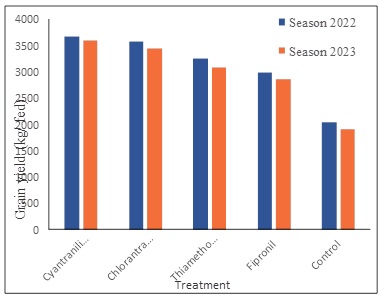
The ability of seed treatments with four insecticides to reduce damage to maize by the fall armyworm (FAW) scientifically known as Spodoptera frugiperda (J. E. Smith) were evaluated and their effect on crop performance over 2 years. FAW larval infestations were significantly reduced by fipronil, chlorantraniliprole, cyantraniliprole and thiamethoxam seed treatments relative to the untreated control, particularly in the diamide insecticides treated plots. Over that 2022 and 2023, seed treatments with cyantraniliprole and chlorantraniliprole significantly reduced the mean larval density (1.50 to 1.70 larvae per 20 plants) compared to the untreated control (4.85 to 5 larvae per 20 plants) while, other seed treatments (thiamethoxam and fipronil) limited larval density by 2.68 to 2.78 larvae per 20 plants. The residual efficacy/protection extended up to 35 days after maize emergence, consequent improvement in maize plant and yield. Therefore, all seed treatments tested produced the most significant both number of ears and weight of grains relative to a non-treated control. Yields were higher in seed treatments than in the untreated seed in both years; hence it is recommended that this setting be utilized for better maize production.

Graphical Abstract

Field Efficacy of Seed Treatment Recent Insecticides in maize on Fall Armyworm (Spodoptera frugiperda J. E. Smith) and Crop Performance.

Keywords

Subjects


  1. IIMR, World maize scenario. https://iimr.icar.gov.in/world-maze-scenario/. (Accessed 26 July 2021). [Crossref], [Google Scholar], [Publisher]
  2. Ismail SM. Field evaluation of whorl application of sand mixed or spray insecticides against Spodoptera frugiperda (Lepidoptera: Noctuidae) on yield of maize. Bulletin of the National Research Centre. 2024 Feb 15;48(1):22. [Crossref], [Google Scholar], [Publisher]
  3. Ismail SM. Side effects of compounds commonly used against spodoptera frugiperda (je smith) on the predator chrysoperla carnea (stephens) in maize fields of egypt. Journal of Agricultural Sciences and Engineering. 2024 Jan 1;6(2):96-102. [Crossref], [Google Scholar], [Publisher]
  4. Vojvodić M, Bažok R. Future of insecticide seed treatment. Sustainability. 2021 Aug 6;13(16):8792. [Crossref], [Google Scholar], [Publisher]
  5. Pes MP, Melo AA, Stacke RS, Zanella R, Perini CR, Silva FM, Carús Guedes JV. Translocation of chlorantraniliprole and cyantraniliprole applied to corn as seed treatment and foliar spraying to control Spodoptera frugiperda (Lepidoptera: Noctuidae). PLoS One. 2020 Apr 1;15(4):e0229151.[Crossref], [Google Scholar], [Publisher]
  6. Afzal I, Javed T, Amirkhani M, Taylor AG. Modern seed technology: Seed coating delivery systems for enhancing seed and crop performance. Agriculture. 2020 Nov 5;10(11):526.[Crossref], [Google Scholar], [Publisher]
  7. DeVries TA, Wright RJ. Evaluation of seed applied treatments and liquid insecticide formulations at planting for larval corn rootworm control, 2020. Arthropod Management Tests. 2021 Jan 1;46(1):tsab083. [Crossref], [Google Scholar], [Publisher]
  8. Suganthi A, Krishnamoorthy SV, Sathiah N, Rabindra RJ, Muthukrishnan N, Jeyarani S, Karthik P, Selvi C, Kumar GA, Srinivasan T, Harishankar K. Bioefficacy, persistent toxicity, and persistence of translocated residues of seed treatment insecticides in maize against fall armyworm, Spodoptera frugiperda (JE Smith, 1797). Crop Protection. 2022 Apr 1;154:105892. [Crossref], [Google Scholar], [Publisher]
  9. Parmar PR, Bhanderi GR, Desai HR, Patel RD. Efficacy of seed treatment chemicals against sucking pests of Bt cotton. International Journal of Agriculture Sciences. 2023 15(1):12153-12156. [Crossref], [Google Scholar], [Publisher]
  10. Chanda M, De Groote H, Kinoti L, Munsaka A, Kuntashula E, Bruce AY, Nkonde C. Farmer evaluation of pesticide seed-coating to control fall armyworm in maize. Crop Protection. 2021 Oct 1;148:105691. [Crossref], [Google Scholar], [Publisher]
  11. Triboni Y, Luciano J, Carlos R, Matheus MN. Effect of seed treatment with insecticides on the control of Spodoptera frugiperda (J. E. Smith) (Lepidoptera:Noctuidae) in soybean. Arquivos do Instituto Biológico. 2019 86. [Crossref], [Google Scholar], [Publisher]
  12. Dobariya UR, Sisodiya DB. Evaluation of insecticides as seed treatment against fall armyworm, Spodoptera frugiperda (J. E. Smith infesting fodder maize, Zea mays). The Pharma Innovation Journal 2022 SP-11(9):1144-1148. [Crossref], [Google Scholar], [Publisher]
  13. Oliveira C, Orozco-Restrepo SM, Alves ACL, Pinto BS, Miranda MS, Barbosa MHP, Picanço MC, Pereira EJG. Seed treatment for managing fall armyworm as defoliator and cutworm on maize: Plant protection, residuality, and the insect life history. Pest Management Science. 2022 Dec78(3):1240–1250. [Crossref], [Google Scholar], [Publisher]
  14. Saxena S, Badaya AK, Suman S, Baghla K, Yadav N, Seervi S. Effect of seed treatment on sorghum yield, germination and oviposition of Atherigona soccata Biological Forum – An International Journal. 2023 15(10):1289- 1293. [Google Scholar], [Publisher]
  15. Utono IM, Adamu RS. Effect of belt expert (flubendiamide + thiacloprid), imidacloprid, thiamethoxam seed treatment and economic impact on fall armyworm (Spodoptera frugiperda) infestation on maize in Nigeria. Cogent Food & Agriculture. 2023 9(1). [Crossref], [Google Scholar], [Publisher]
Volume 6, Issue 4
Autumn 2024
Pages 218-223

  • Receive Date 08 November 2024
  • Revise Date 19 December 2024
  • Accept Date 31 December 2024